
What this industry manufactures
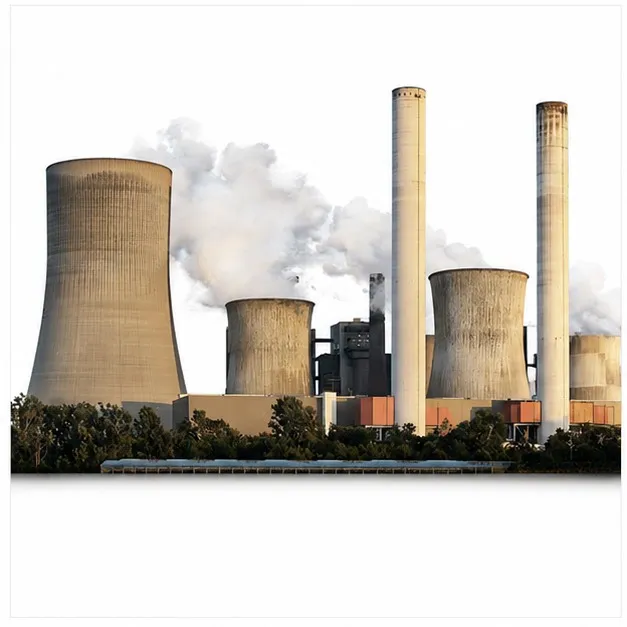
Cooling tower fabricators build the casing panels and shell sections that enclose the tower, along with louvers, air inlet screens, the cold water collection basin, internal partition walls, fan cylinders/stacks, and structural components such as ladders and handrails. Towers range from small packaged units serving a single chiller plant to large induced-draft towers built for power stations, refineries and process industries.
Why GP Clear Resin is suitable
FRP cooling tower components are built the same way as most general-purpose FRP laminates — layers of glass reinforcement wetted out with resin and cured at room temperature — so the resin needs to behave predictably across large, often flat or gently curved panels. GP Clear Resin's 350–450 cPs viscosity wets out reinforcement evenly over these panel areas without pooling, and its non-accelerated cure gives fabricators control over gel timing when several panels are being laminated in the same shift. Where the circulating water is dosed with aggressive biocides or scale inhibitors, some fabricators step up to a vinyl ester resin for extra chemical resistance — but for standard treated cooling water, GP Clear Resin's cured laminate holds up well within its intended service life.
Required resin characteristics
- 01Even wet-out over large, often flat panel surfaces without dry patches
- 02A gel time that stays workable across a full production shift of panel lamination
- 03Cured mechanical strength sufficient for structural casing panels and internal partitions
- 04Stable performance under continuous moisture exposure and moderate warm-water temperatures
- 05Batch-to-batch consistency so panel thickness and strength don't vary across a large tower's casing
Manufacturing process
Casing panels and structural sections are laminated by hand lay-up over flat or gently profiled moulds: chopped strand mat is placed and wet out with resin catalysed by an MEKP hardener and cobalt octoate accelerator, with additional layers and ribbing built up where panels need extra stiffness. Louvers and smaller components are often laminated in dedicated moulds for consistent profiles. Once cured at room temperature, panels are trimmed, drilled for assembly, and bolted or bonded together on site to form the complete tower structure.
Advantages
- Fast gel time (under 8 minutes) supports efficient panel-by-panel production without long waits between lay-up passes
- Non-accelerated system lets fabricators tune MEKP and cobalt octoate dosage to match workshop temperature across a production run
- 225 kg drum packaging suits the continuous resin consumption of large-panel cooling tower manufacturing
- Consistent 99% purity reduces the risk of resin-rich or resin-starved zones that could weaken a structural panel
Common products produced
- FRP cooling tower casing and shell panels
- Louvers and air inlet screens
- Cold water collection basins
- Internal partition walls and fan cylinders/stacks
- Structural ladders and handrails
Frequently asked questions
GP Clear Resin is commonly used for casing panels, louvers and structural components. For internal areas exposed to continuous circulating water with water-treatment chemicals, check the specific chemical dosing against the resin's resistance — a vinyl ester resin is often preferred for the most aggressive wet-deck environments.
Panels are typically laminated with E-glass chopped strand mat, with additional layers added at ribs and edges for stiffness. Samrat Poly Resins supplies chopped strand mat reinforcement alongside its resin range.
Yes, for standard cooling tower operating temperatures. Its cured laminate is stable under continuous moisture and moderate warm-water exposure typical of induced-draft and packaged cooling towers.
It is cured at room temperature with an MEKP catalyst (around 1.5%) and a cobalt octoate accelerator (around 0.4%), the same non-accelerated system used across Samrat Poly Resins' general-purpose grades — dosage is adjusted to suit the pace of panel production.
It suits the panel sizes typical of both packaged and field-erected cooling towers — fabricators adjust laminate thickness and reinforcement layers to match the structural loads of the specific tower design.
Need resin for your cooling tower production?
Get a bulk quote or talk to our technical team about the right grade and dosage for your panel fabrication line.