Tooling Grade Resin
SPR 401 TLIsophthalic NPG-based polyester tooling resin (SPR 401 code range)SPR 301 · Isophthalic Polyester Resins
Highly reactive, high-molecular-weight isophthalic NPG-based polyester resin for composite mould production.
Review the official product data sheet for specifications and application information.
Price
Price on Request
Industrial resin pricing varies based on:
- Order Quantity
- Resin Grade
- Current Raw Material Rates
Product details
| Catalogue Code | SPR 401 TL |
|---|---|
| Resin Chemistry | Isophthalic NPG (neopentyl glycol)-based unsaturated polyester |
| Supply Condition | Non-accelerated · moderately thixotropic |
| Reference Cure System | MEKP 1.5% + Cobalt Octoate 0.4% — added separately during use |
Typical specification
| Appearance | Opaque, cloudy to milky liquid |
|---|---|
| Viscosity, 60 rpm | 400–650 cPs |
| Viscosity, 6 rpm | 1,500–2,500 cPs |
| Thixotropic Index | 2.5–3.8 |
| Gel Time | 15–30 minutes at 25 °C |
| Specific Gravity | 1.12–1.16 |
| Styrene Content | 35–42% by weight |
Typical values from the Samrat Poly Resins product catalogue, 2026 edition. They are not guaranteed specifications or finished-component properties; confirm the current values for your order and trial the grade on your own process.
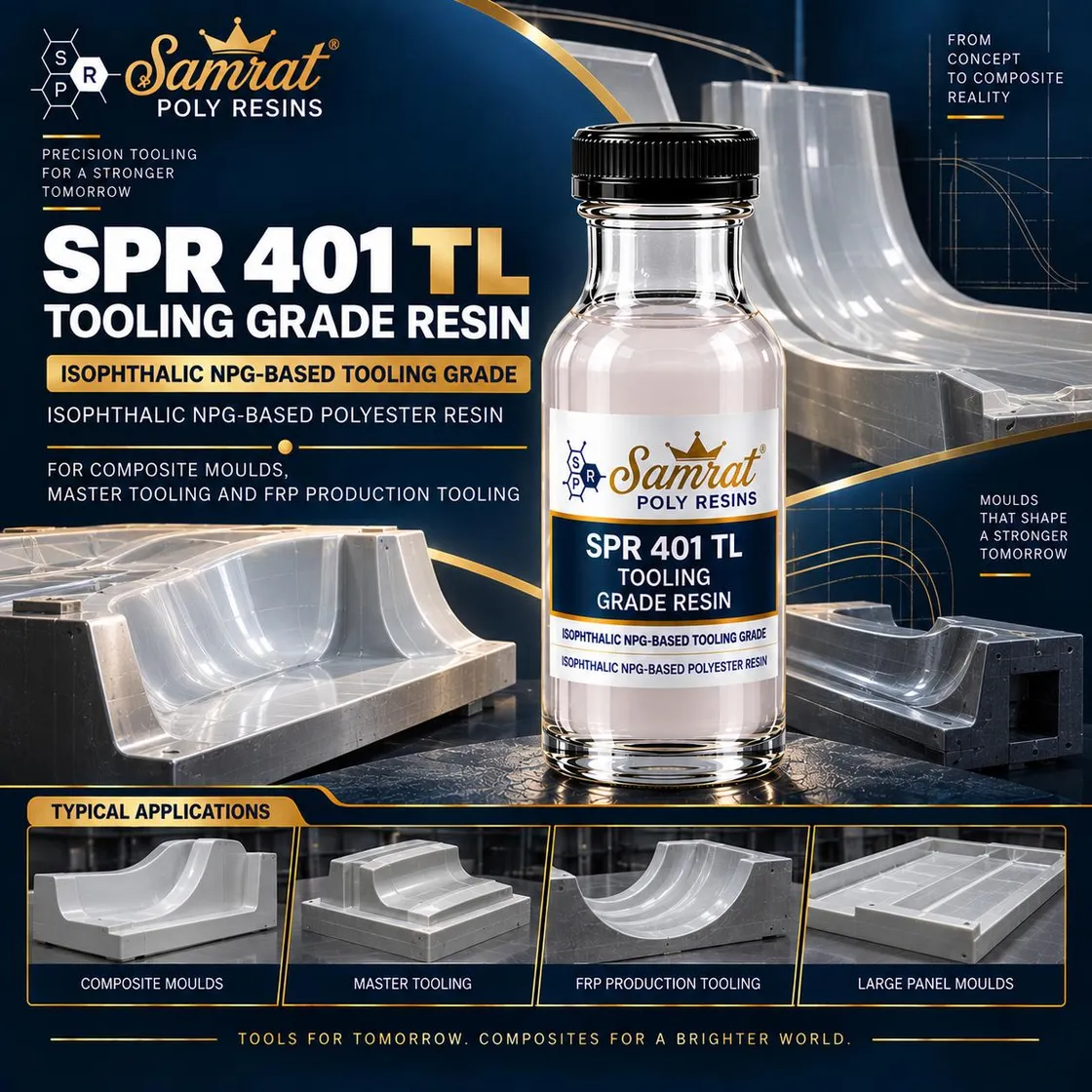
SPR 401 TL is a highly reactive, high-molecular-weight isophthalic NPG (neopentyl glycol)-based polyester resin for composite mould production, listed for composite mould production and tooling and die preparation. It carries an SPR 401 code but is an isophthalic grade, not a terephthalic resin. It is supplied non-accelerated and moderately thixotropic, with MEKP and cobalt octoate added separately during use.
The SPR 401 code range is otherwise the terephthalic family; the catalogue retains the TL tooling resin within it while stating that it is an isophthalic NPG-based grade. This site therefore lists it with the isophthalic polyester resins.
Key features
- Isophthalic NPG-based tooling resin (SPR 401 TL)
- Highly reactive, high-molecular-weight resin, per the catalogue
- Moderately thixotropic; typical thixotropic index 2.5–3.8
- Typical gel time 15–30 minutes at 25 °C
Applications
- Composite mould production
- Tooling and die preparation
Product role
A production mould is laminated once and then pulls many parts, so its laminate has to hold dimension and surface through repeated heat cycles from curing parts. The catalogue lists SPR 401 TL — an isophthalic, NPG-based, highly reactive grade — for building composite moulds and for tooling and die preparation.
Mould build schedules, post-cure and the tooling gelcoat are part of the mould's performance as much as the resin is. Share the mould size, the part it will produce and the expected cycle count when enquiring.
Retained within the SPR 401 code range; this is an isophthalic NPG-based grade, not a terephthalic resin.
Supply and cure
- Supply condition
- Non-accelerated · moderately thixotropic
- Reference cure system
- MEKP 1.5% + Cobalt Octoate 0.4% — added separately during use
Processes and where this grade fits
SPR 401 TL is an isophthalic NPG-based, moderately thixotropic grade for building composite moulds and for tooling and die preparation. It carries an SPR 401 code but is not a terephthalic resin.
| Process or use | Role of this grade | What to confirm |
|---|---|---|
| Laminating composite production moulds | Listed role | Build sequence, stage thickness, heat build-up and post-cure |
| Tooling and die preparation | Listed role | The tool’s dimensional requirement and service temperature |
| Tooling gelcoat layer | Use a gelcoat | The mould surface is a gelcoat, not the tooling resin |
| Parts pulled from the finished mould | Not this grade’s role | The laminating grades suited to the part |
Process-selection considerations
- Think about the mould’s life, not one laminate. A production mould pulls many parts and sees repeated heat from curing parts.
- Plan the build: tooling gelcoat, skin laminate and bulk laminate built in stages. Thick single stages cause heat build-up and distortion.
- The thixotropy — 400–650 cPs at 60 rpm, 1,500–2,500 cPs at 6 rpm, index 2.5–3.8 — helps the resin stay on vertical pattern faces.
- Typical gel time is 15–30 minutes at 25 °C at the reference cure, MEKP 1.5% with cobalt octoate 0.4% added separately.
- Share the mould size, the part it will produce and the expected number of pulls.
Limitations and trial requirements
- The catalogue describes the grade as highly reactive and NPG-based; no heat-distortion, shrinkage or mechanical values are published for SPR 401 TL.
- Mould quality depends on the pattern, gelcoat, build schedule and post-cure as much as the resin.
- The SPR 401 code does not mean terephthalic chemistry: SPR 401 TL is isophthalic.
- Trial the grade on the real part, mould and shop conditions before production. The catalogue values are typical liquid-resin properties, not guaranteed limits or finished-part performance.
Before you select this grade
- The values on this page are typical. Final selection should be confirmed against your own process, a trial result and the current technical documentation for the grade.
- The Technical Data Sheet linked on this page carries these same typical values. No Safety Data Sheet is published on this site for this grade; request current safety information before use.
- Never mix a concentrated peroxide initiator directly with a cobalt accelerator. Add each to the resin separately, according to the confirmed process.
- Store resin, initiators and accelerators separately, in original sealed containers, cool, shaded and away from heat and ignition sources. Use suitable personal protective equipment and adequate ventilation.