Pultrusion Grade Resin
SPR 401 PTTerephthalic pultrusion grade — heat-activated peroxide cure, not ambient MEKP/cobaltSPR 401 · Terephthalic Polyester Resins
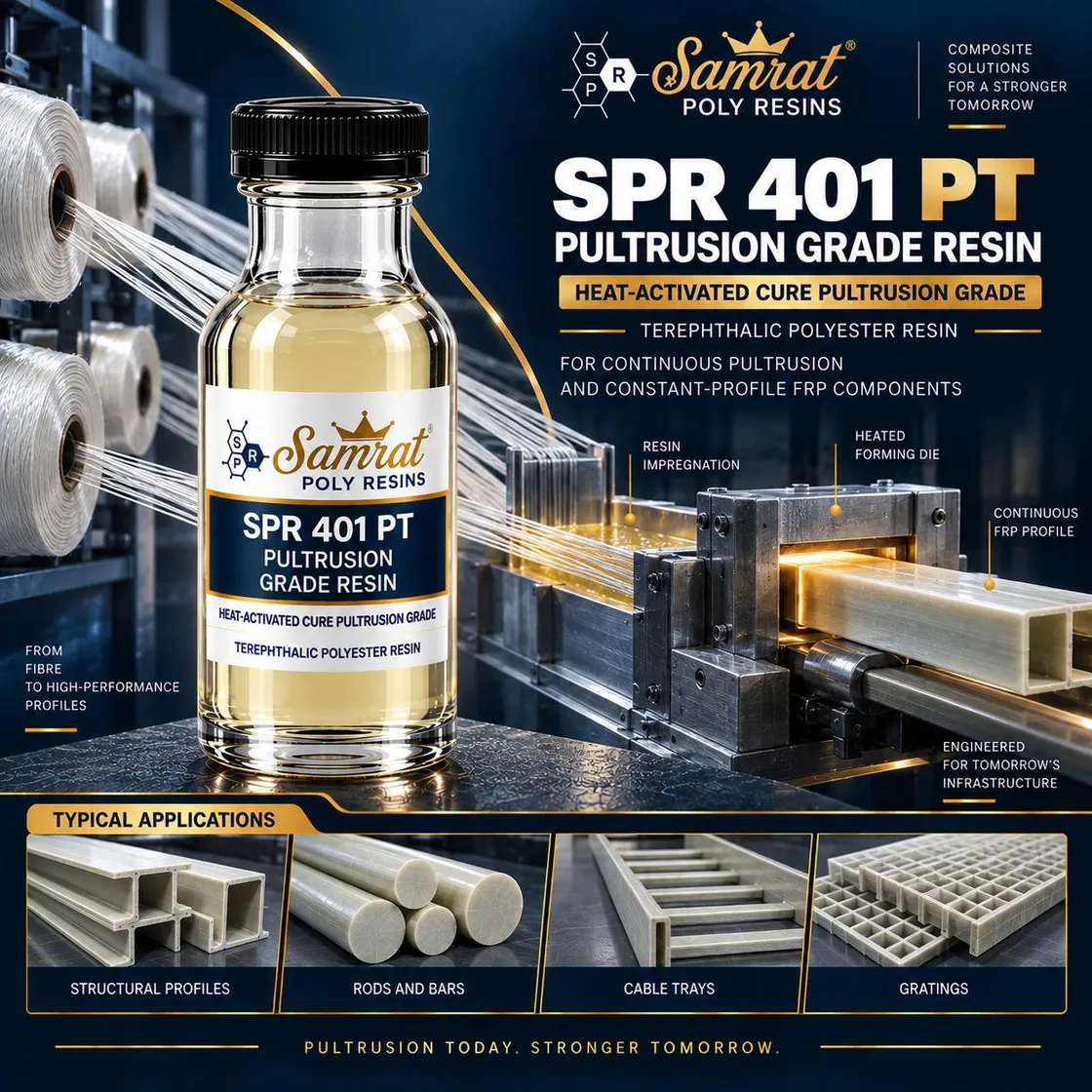
High-strength terephthalic grade with excellent mechanical properties for continuous pultrusion.
Review the official product data sheet for specifications and application information.
Price
Price on Request
Industrial resin pricing varies based on:
- Order Quantity
- Resin Grade
- Current Raw Material Rates
Product details
| Catalogue Code | SPR 401 PT |
|---|---|
| Resin Chemistry | Terephthalic unsaturated polyester |
| Supply Condition | Non-accelerated · non-thixotropic |
| Production Cure | Heat-activated peroxide blend, total dosage 1.0–2.0% — added separately during processing |
| Production MEKP | 0% |
| Production Cobalt | 0% |
Typical specification
| Appearance | Clear, light-straw to amber liquid |
|---|---|
| Viscosity | 300–600 cPs at 25 °C |
| Hot-Die Gel Time | 40–80 seconds at 130–140 °C |
| Ambient QC Gel Time | 15–25 minutes at 25 °C |
| Specific Gravity | 1.10–1.14 |
| Styrene Content | 36–42% by weight |
Typical values from the Samrat Poly Resins product catalogue, 2026 edition. They are not guaranteed specifications or finished-component properties; confirm the current values for your order and trial the grade on your own process.
SPR 401 PT is the high-strength terephthalic pultrusion grade of the SPR 401 family, with excellent mechanical properties per the catalogue, for continuous pultrusion processing and pultruded FRP profiles and structural sections. Production pultrusion uses a heat-activated peroxide system — not the ambient MEKP and cobalt system. It is supplied non-accelerated and non-thixotropic.
The heat-activated production cure is set by the pultrusion line — die temperature, pull speed and the peroxide blend chosen. The ambient QC gel time in the specification is a quality-control figure, not a production setting.
Key features
- Terephthalic pultrusion grade (SPR 401 PT)
- High strength and excellent mechanical properties, per the catalogue
- Hot-die gel time 40–80 seconds at 130–140 °C
- Heat-activated peroxide production cure; 0% MEKP and 0% cobalt in production
Applications
- Continuous pultrusion processing
- Pultruded FRP profiles and structural sections
Product role
Pultrusion pulls resin-impregnated roving and mat continuously through a heated die, where the profile has to cure in the seconds it spends in the hot zone. That is why SPR 401 PT is specified by a hot-die gel time — 40 to 80 seconds at 130–140 °C — and cured with a heat-activated peroxide blend rather than the room-temperature MEKP and cobalt system used by laminating grades.
Supply and cure
- Supply condition
- Non-accelerated · non-thixotropic
- Production cure
- Heat-activated peroxide blend, total dosage 1.0–2.0% — added separately during processing
Production cure, exactly as the catalogue prints it: heat-activated peroxide blend, total dosage 1.0–2.0% — added separately during processing. Production MEKP: 0%. Production cobalt: 0%.
Die temperature profile, pull speed, filler loading and the peroxide blend are line-specific. Trial on the production line before commercial runs.
Processes and where this grade fits
SPR 401 PT is a terephthalic pultrusion grade. In production it is cured in a heated die by a heat-activated peroxide blend — production MEKP and production cobalt are both 0%.
| Process or use | Role of this grade | What to confirm |
|---|---|---|
| Continuous pultrusion of profiles and structural sections | Listed role | Die temperature profile, pull speed, filler loading and the peroxide blend |
| Resin bath or injection-box impregnation | Part of the pultrusion line | Wet-out of roving and mat at 300–600 cPs typical |
| Filament winding | Different process — consider SPR 301 FW | Winding cures at ambient on a mandrel |
| Hand lay-up or spray-up | Not this grade’s role | Ambient-cure laminating grades |
Process-selection considerations
- Specify by hot-die gel time: 40–80 seconds at 130–140 °C typical. That is the figure that matters in a pultrusion die.
- The production cure is a heat-activated peroxide blend at 1.0–2.0% total dosage, added separately during processing. Do not substitute the ambient MEKP and cobalt system.
- The ambient QC gel time, 15–25 minutes at 25 °C, is a laboratory check of the resin, not a production condition.
- Share the profile cross-section, reinforcement, filler loading, line speed and die length.
- Plan line trials: die temperature profile, pull speed and blend are line-specific.
Limitations and trial requirements
- Production MEKP: 0%. Production cobalt: 0%. The grade is not intended for room-temperature MEKP/cobalt cure in production.
- The catalogue describes the pultrusion grade as high-strength; no numerical mechanical values are published for SPR 401 PT. Profile properties belong to the tested profile.
- Pultruded profile performance depends on fibre architecture, glass content and cure as much as on the resin.
- Trial the grade on the real part, mould and shop conditions before production. The catalogue values are typical liquid-resin properties, not guaranteed limits or finished-part performance.
Before you select this grade
- The values on this page are typical. Final selection should be confirmed against your own process, a trial result and the current technical documentation for the grade.
- The Technical Data Sheet linked on this page carries these same typical values. No Safety Data Sheet is published on this site for this grade; request current safety information before use.
- Never mix a concentrated peroxide initiator directly with a cobalt accelerator. Add each to the resin separately, according to the confirmed process.
- Store resin, initiators and accelerators separately, in original sealed containers, cool, shaded and away from heat and ignition sources. Use suitable personal protective equipment and adequate ventilation.