Orthophthalic Cooling Tower Grade Resin
SPR 201 CTGThixotropic orthophthalic grade for sag-resistant lay-upSPR 201 · Orthophthalic Polyester Resins
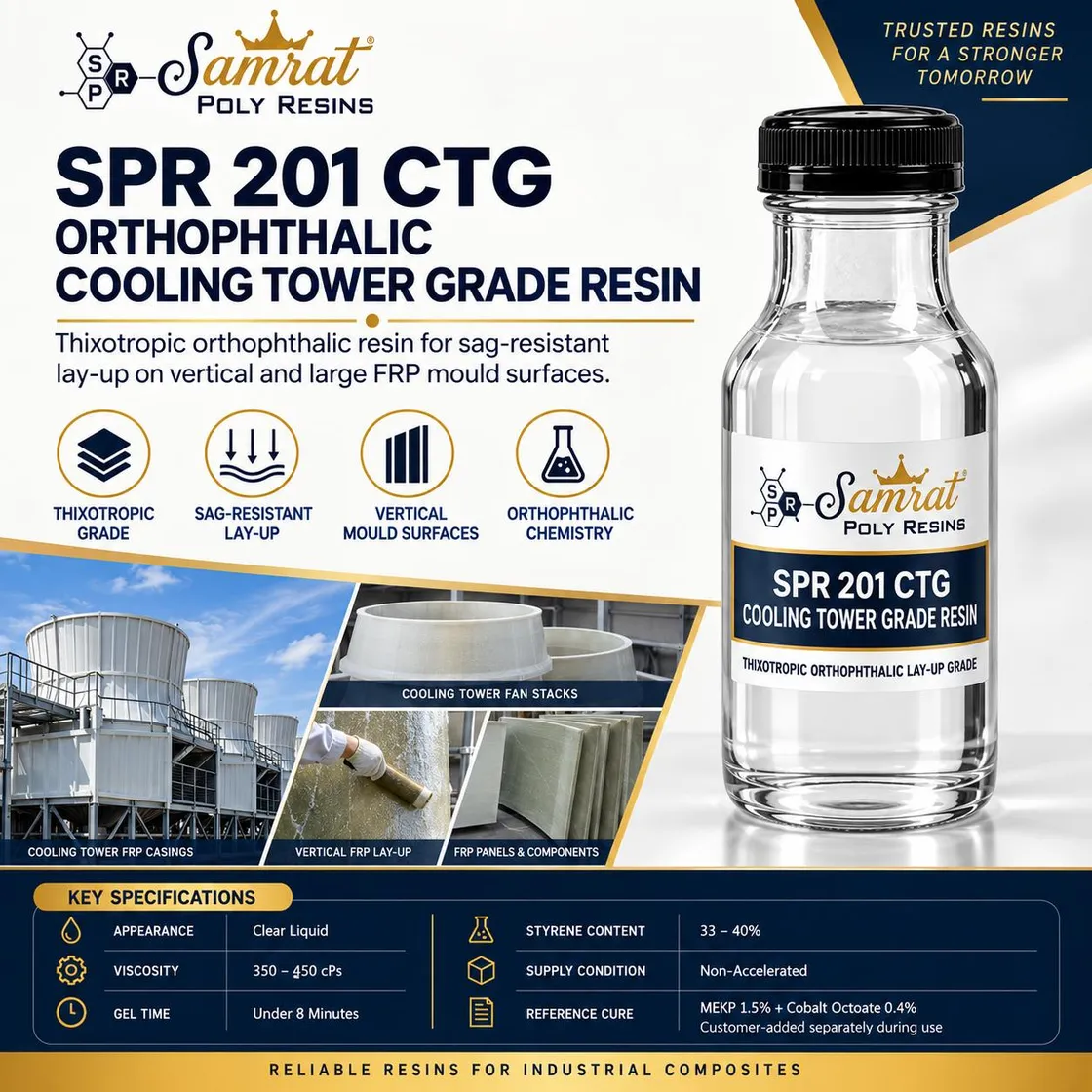
Thixotropic orthophthalic grade for sag-resistant lay-up on vertical and large surfaces.
Review the official product data sheet for specifications and application information.
Price
Price on Request
Industrial resin pricing varies based on:
- Order Quantity
- Resin Grade
- Current Raw Material Rates
Product details
| Catalogue Code | SPR 201 CTG |
|---|---|
| Resin Chemistry | Orthophthalic unsaturated polyester |
| Supply Condition | Non-accelerated |
| Reference Cure System | MEKP 1.5% + Cobalt Octoate 0.4% — added separately during use |
Typical specification
| Appearance | Clear liquid |
|---|---|
| Viscosity | 350–450 cPs |
| Gel Time | Under 8 minutes |
| Styrene Content | 33–40% |
Typical values from the Samrat Poly Resins product catalogue, 2026 edition. They are not guaranteed specifications or finished-component properties; confirm the current values for your order and trial the grade on your own process.
SPR 201 CTG is the thixotropic orthophthalic grade of the SPR 201 family, listed for cooling-tower FRP components, wind-turbine FRP components and sag-resistant lay-up on vertical surfaces. It is supplied non-accelerated and cured with MEKP and cobalt octoate added separately during use.
Where the cooling-tower part has to be isophthalic — for heat, chemical or corrosion service — the catalogue lists SPR 301 CT, Isophthalic Cooling Tower Grade Resin.
Key features
- Thixotropic orthophthalic grade (SPR 201 CTG)
- Listed for sag-resistant lay-up on vertical and large surfaces
- Typical viscosity 350–450 cPs and gel time under 8 minutes
- Supplied non-accelerated; MEKP and cobalt octoate added during use
Applications
- Cooling-tower FRP components
- Wind-turbine FRP components
- Sag-resistant lay-up on vertical surfaces
Product role
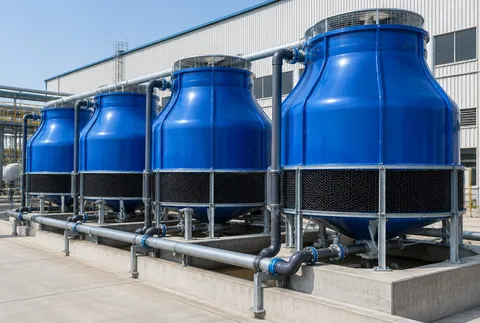
Cooling-tower casings, fan stacks and similar panels are laid up on large and vertical mould faces, where a resin that drains before it gels leaves resin-starved laminate at the top and runs at the bottom. SPR 201 CTG is the catalogue's thixotropic orthophthalic answer to that lay-up problem.
The catalogue's selection guide notes that the CTG and CC grades share SPR 201 GPC's typical specification; what distinguishes CTG is its thixotropic, sag-resistant role. Confirm the sag behaviour on your own mould, laminate thickness and shop temperature before production.
Supply and cure
- Supply condition
- Non-accelerated
- Reference cure system
- MEKP 1.5% + Cobalt Octoate 0.4% — added separately during use
Processes and where this grade fits
SPR 201 CTG is a thixotropic laminating grade. Its role is open-mould lay-up on large and vertical surfaces, where sag resistance is the deciding property.
| Process or use | Role of this grade | What to confirm |
|---|---|---|
| Hand lay-up of cooling-tower casings, fan stacks and panels | Listed role | Sag and drainage on the real mould face, laminate thickness per stage and shop temperature |
| Wind-turbine FRP components | Listed role | Which component, and whether the turbine maker specifies a resin system or qualification |
| Other vertical or overhead lay-up | Listed role — sag-resistant lay-up | Wet-out of the chosen reinforcement at the thixotropic viscosity |
| Cooling-tower parts in hot, chemically treated water | Consider the isophthalic grade | SPR 301 CT is the catalogue’s isophthalic cooling-tower grade |
| Flat moulds and general lamination | Not the reason to choose CTG | A non-thixotropic GP grade such as SPR 201 GPC is usually the simpler starting point |
Process-selection considerations
- Choose CTG for the lay-up problem, not the end market. Its reason to exist is holding resin on a vertical face long enough to gel without draining.
- Separate the structural need from the service need. Sag resistance is a processing property; hot water and treatment chemicals are a service question that may point to the isophthalic SPR 301 CT instead.
- State the component: casing panel, fan stack, basin, louvre or wind-turbine part. Each has a different laminate schedule and exposure.
- Confirm the reinforcement and laminate thickness per stage. Heavier stages on a vertical face test sag resistance hardest.
- The reference cure, MEKP 1.5% with cobalt octoate 0.4% added separately, is the catalogue’s measurement condition. Shop temperature changes the working window; settle production dosage by trial.
Limitations and trial requirements
- The catalogue publishes the same typical liquid values as SPR 201 GPC — appearance, 350–450 cPs viscosity, gel time under 8 minutes and 33–40% styrene — plus the thixotropic, sag-resistant role. It does not publish a thixotropic index for this grade.
- No heat-resistance, hot-water, chemical-resistance or mechanical value is published for CTG. Orthophthalic chemistry is the general-purpose family; it is not the catalogue’s choice for hot or chemical service.
- Wind-turbine blades are not a listed application. Primary blade structures are normally built to the turbine maker’s own qualified resin system.
- Trial the grade on the real part, mould and shop conditions before production. The catalogue values are typical liquid-resin properties, not guaranteed limits or finished-part performance.
Before you select this grade
- The values on this page are typical. Final selection should be confirmed against your own process, a trial result and the current technical documentation for the grade.
- The Technical Data Sheet linked on this page carries these same typical values. No Safety Data Sheet is published on this site for this grade; request current safety information before use.
- Never mix a concentrated peroxide initiator directly with a cobalt accelerator. Add each to the resin separately, according to the confirmed process.
- Store resin, initiators and accelerators separately, in original sealed containers, cool, shaded and away from heat and ignition sources. Use suitable personal protective equipment and adequate ventilation.