What this industry manufactures
Spray-up is used for products where higher-volume production and moderate part complexity make chopper-gun application worthwhile — water tanks, panels, cooling tower components and similar moulded shapes with large surface areas benefit most from the process's speed advantage over manual lay-up.
Why GP Yellow Resin is suitable
Spray-up puts more precise demands on viscosity than hand lay-up, since resin has to atomise cleanly through a chopper gun's nozzle and pump rather than simply spreading under a roller. GP Yellow Resin's 450–600 cPs body is thicker than GP Clear Resin's 350–450 cPs, and while many spray-up rigs can be calibrated — nozzle size, pump pressure — to handle that difference, it is not guaranteed to run cleanly on every setup without adjustment. GP Clear Resin's lower viscosity remains the safer default for spray equipment compatibility; GP Yellow Resin is workable for fabricators willing to confirm and, if needed, recalibrate their specific chopper gun setup first, and its longer 10–15 minute gel time still gives useful extra time to build up thickness across a mould once it is running.
Required resin characteristics
- 01A viscosity that atomises through chopper-gun equipment once calibrated for a thicker body than a low-viscosity spray resin
- 02Predictable gel timing that can be tuned to the spray rate and size of the mould
- 03Even resin distribution alongside chopped roving as it's deposited on the mould
- 04Reliable mechanical strength once the sprayed laminate is compacted and cured
- 05Consistent behaviour across repeated spray cycles once equipment is correctly set up
Manufacturing process
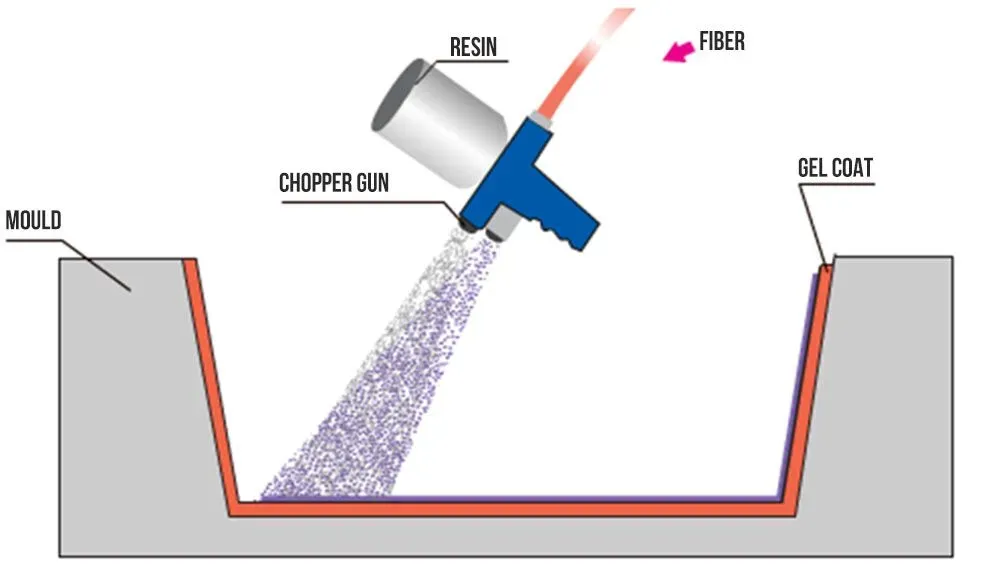
In spray-up, GP Yellow Resin, catalysed with an MEKP hardener and cobalt octoate accelerator, is fed through a chopper gun alongside continuous glass roving, which is cut and deposited onto the mould simultaneously with the resin spray — nozzle size and pump pressure may need adjusting from a low-viscosity setup to handle GP Yellow Resin's thicker body cleanly. The sprayed laminate is then compacted with a roller to remove air and ensure the resin has fully wet out the chopped glass fibre. Multiple passes build up the required thickness before the part cures at room temperature and is released from the mould.
Advantages
- Longer 10–15 minute gel time gives more time to build up thickness across a mould once spraying
- Same non-accelerated MEKP/cobalt octoate cure system as GP Clear Resin
- Consistent 99% purity maintains laminate quality across a production run
- Workable through spray-up equipment calibrated for its thicker body
Common products produced
- Water tanks and panels produced at volume
- Cooling tower panels and casings
- General FRP panels with large surface areas
Frequently asked questions
It can be, but its 450–600 cPs viscosity is thicker than GP Clear Resin's 350–450 cPs, so nozzle size and pump pressure may need recalibrating from a low-viscosity setup. Confirm compatibility with your specific spray equipment before committing to a production run; GP Clear Resin remains the safer default if you'd rather not adjust equipment settings.
Mainly where GP Yellow Resin is already the preferred general-purpose grade for other reasons — cost, supply, or its longer gel time — and the spray equipment has already been calibrated for its thicker body. Not because it sprays more easily than GP Clear Resin, which remains the lower-viscosity, easier default for spray equipment.
Gel time is tuned to the operator's spray rate and mould size using the cobalt octoate accelerator dosage, the same as with GP Clear Resin. GP Yellow Resin's own base gel time of 10–15 minutes is already longer, so accelerator dosing may be adjusted accordingly to match the production line's pace.
No — spray-up uses continuous glass roving fed through the chopper gun and cut on application, rather than pre-cut chopped strand mat. GP Yellow Resin's role in wetting out that reinforcement is the same as in hand lay-up.
It is cured at room temperature with an MEKP catalyst (around 1.5%) and a cobalt octoate accelerator (0.3–0.5%), with dosage adjusted to the operator's spray rate and the specific equipment being used.
Need GP Yellow Resin for your spray-up production?
Get a bulk quote for GP Yellow Resin, or talk to our technical team about whether your spray equipment is suited to GP Yellow Resin or GP Clear Resin.