
What this industry manufactures
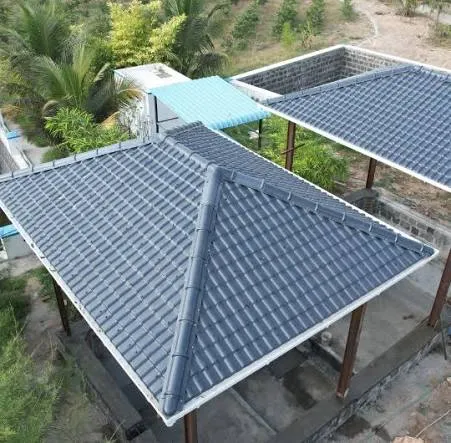
Roofing sheet manufacturers produce corrugated and flat FRP sheets in standard profiles for industrial roofing, cladding and daylighting panels, along with ridge caps, flashing pieces and ancillary fittings used to complete a roof installation. Sheet widths and corrugation profiles are typically standardised to match common steel roofing profiles.
Why GP Yellow Resin is suitable
Because roofing sheets are laminated in thin, wide sections, wet-out speed and consistency matter more here than in a thicker structural laminate — any dry patch shows up quickly as a weak point under roof load or wind uplift. GP Yellow Resin's 450–600 cPs viscosity is thicker than GP Clear Resin's 350–450 cPs, which in turn is thicker than the purpose-built Sheet Grade Yellow Resin (around 280 cPs) that Samrat Poly Resins formulates specifically for sheet and panel work. GP Yellow Resin can still be worked into a roofing sheet laminate with careful rolling to avoid dry patches, and its longer 10–15 minute gel time gives more time to do that across a wide sheet mould — but for fabricators prioritising minimum labour and dry-patch risk on thin sheet sections specifically, the lower-viscosity Sheet Grade Yellow Resin or GP Clear Resin are the better-suited starting point.
Required resin characteristics
- 01Even wet-out across wide, thin sheet moulds despite a thicker body than a dedicated sheet-grade resin
- 02A workable gel time to spread and roll resin through the corrugation profile before it sets
- 03Reliable room-temperature cure so sheets can be demoulded on a predictable schedule
- 04Adequate flexural strength for a thin laminate carrying roof loads and wind uplift
- 05Batch consistency so sheet thickness and strength don't drift across a production run
Manufacturing process
Roofing sheets are laminated over a corrugated mould bed: chopped strand mat is laid into the corrugation profile and wet out with GP Yellow Resin, catalysed by an MEKP hardener and cobalt octoate accelerator, worked through with a roller to remove air and reach even thickness across every corrugation — its thicker body needs a little more rolling attention than a low-viscosity sheet-grade resin to avoid dry patches. Sheets cure at room temperature, often under a cover sheet to control surface finish, before being trimmed to length and stacked.
Advantages
- Longer 10–15 minute gel time gives more time to roll resin evenly through a wide corrugated mould
- Same non-accelerated MEKP/cobalt octoate cure system as GP Clear Resin
- 225 kg drum packaging suits steady resin consumption on ongoing sheet production runs
- Consistent 99% purity for predictable batch-to-batch processing
Common products produced
- Corrugated FRP roofing sheets
- Flat FRP cladding panels
- Ridge caps and flashing accessories
- Industrial shed and warehouse roofing systems
Frequently asked questions
For thin, wide roofing sheet sections specifically, a lower-viscosity resin reduces the labour needed to avoid dry patches. GP Yellow Resin (450–600 cPs) is thicker than GP Clear Resin (350–450 cPs), which in turn is thicker than the purpose-built Sheet Grade Yellow Resin (around 280 cPs). GP Yellow Resin can still be used for roofing sheets with careful rolling, but Sheet Grade Yellow Resin or GP Clear Resin are the better-suited starting point where minimising dry-patch risk on thin sections is the priority.
GP Yellow Resin is a general-purpose grade also used for tanks, cooling towers and general lamination. Sheet Grade Yellow Resin is factory-pigmented and formulated at a lower viscosity specifically for sheet and panel production, making it the more purpose-built choice for roofing and cladding sheets.
Roofing sheets are typically laminated with E-glass chopped strand mat, laid into the corrugation profile before resin is applied and worked through with a roller — the same reinforcement approach used with GP Clear Resin or Sheet Grade Yellow Resin.
It is cured at room temperature with an MEKP catalyst (around 1.5%) and a cobalt octoate accelerator (0.3–0.5%), with dosage adjusted to suit ambient temperature and the pace of the production line — the same non-accelerated system used across Samrat Poly Resins' general-purpose grades.
Yes, though its existing yellow tint will combine with whatever pigment is added. For a fully controlled, factory-consistent colour across every sheet, Sheet Grade Yellow Resin's pre-pigmented formulation is the more predictable option.
Need GP Yellow Resin for your roofing sheet production?
Get a bulk quote for GP Yellow Resin, or talk to our technical team about whether GP Yellow Resin, GP Clear Resin or Sheet Grade Yellow Resin best suits your sheet lamination line.