
What this industry manufactures
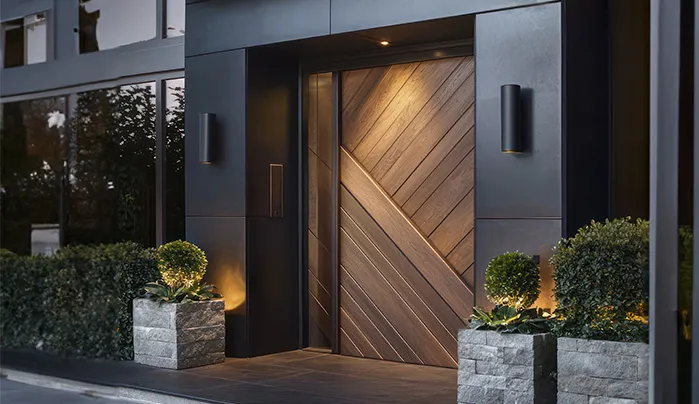
Door lamination work produces laminate-faced flush doors, veneer-faced decorative doors, and doors finished with moulded or textured panel-look laminate sheets — largely for residential, office and hospitality interiors where a decorative, ready-to-finish door surface is needed without the cost of solid timber.
Why Lamination Resin (LR Resin) is suitable
Lamination Resin (LR Resin) is formulated specifically for this bonding step: its 5-minute gel time is faster than a general-purpose resin's, so a laminating press can cycle through more doors per shift, and its 100% purity, transparent liquid form gives a clean, glossy bond line that doesn't discolour the decorative sheet above it. For general FRP door fabrication and frame reinforcement rather than decorative sheet bonding, GP Clear Resin is the more suitable choice.
Required resin characteristics
- 01Fast gel time to keep a laminating press cycling efficiently
- 02Strong, reliable adhesion between the resin bond line and the decorative laminate or veneer sheet
- 03A clear, glossy cured finish that doesn't discolour the sheet above it
- 04Room-temperature or press-assisted cure depending on the production line
- 05Consistent batch-to-batch bonding quality across a production run
Manufacturing process
The door blank surface is coated with resin catalysed by an MEKP hardener and cobalt octoate accelerator, the decorative laminate or veneer sheet is placed on top, and the assembly is pressed — either in a hot press for faster cycles or clamped at room temperature for smaller production runs — until the resin cures and bonds the sheet permanently to the door face. Once cured, edges are trimmed and the door is finished for delivery.
Advantages
- 5-minute gel time supports faster press-cycle turnaround than a general-purpose resin
- Excellent adhesion to laminate and veneer sheets, reducing the risk of peeling or delamination
- Clear, glossy cure gives a clean finish beneath decorative sheets
- Room-temperature cure option available for workshops without hot-press equipment
Common products produced
- Laminate-faced flush doors
- Veneer-faced decorative doors
- Moulded panel-look laminated doors
Frequently asked questions
It's used as the bonding layer between a plain door blank and a decorative laminate or veneer sheet, cured to permanently fix the sheet to the door face.
No. Structural door fabrication (frames, core reinforcement) typically uses a general-purpose resin such as GP Clear Resin. LR Resin is formulated specifically for the faster-cycling decorative bonding step.
Not necessarily — its 5-minute gel time suits both hot-press production lines and room-temperature clamped bonding for smaller-scale door lamination work.
It's cured with an MEKP catalyst (around 1.5%) and a cobalt octoate accelerator (around 0.4%), the same system used across Samrat Poly Resins' general-purpose grades.
This page focuses on synthetic decorative laminate sheets specifically. For solid-wood and wood-core doors finished with a natural wood veneer, see our wooden door lamination guide for the bonding considerations specific to timber veneer.
Need resin for your door lamination line?
Get a bulk quote or talk to our technical team about the right dosage for your press cycle.