
What this industry manufactures
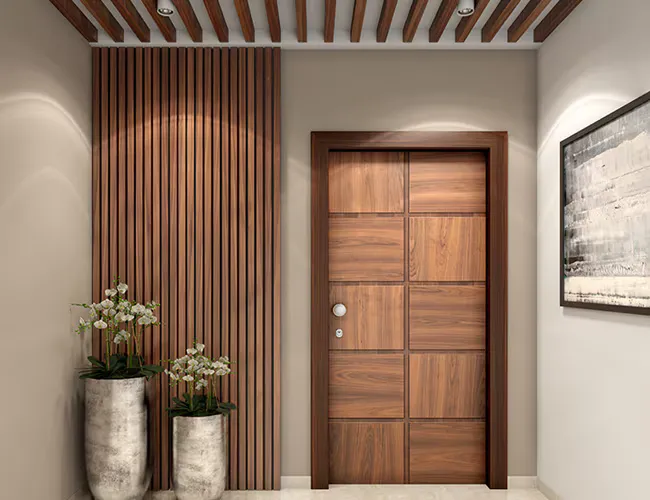
Door skin lamination is the assembly step behind complete FRP and composite door shutters — moulded door skins (produced separately) are bonded to a core material and edge frame to form a finished, structurally sound door ready for hanging and hardware fitting.
Why Lamination Resin (LR Resin) is suitable
Skin-to-core bonding needs a resin that cures quickly enough to keep an assembly line moving without a long clamping wait, while still forming a strong mechanical bond reinforced with glass fibre where the skin meets the core. Lamination Resin (LR Resin)'s 5-minute gel time suits this faster assembly cycle, and it wets out glass fibre reinforcement cleanly at the skin-to-core joint. Where the work is skin moulding itself — producing the decorative panel rather than bonding it to a core — a general-purpose resin such as GP Clear Resin is the more suitable choice, as covered on our door skin manufacturing page.
Required resin characteristics
- 01Fast gel time to keep skin-to-core assembly cycles efficient
- 02Reliable wet-out of glass fibre reinforcement at the bonding joint
- 03Strong mechanical adhesion between the door skin and the core material
- 04Room-temperature cure compatible with clamped or pressed assembly
- 05Consistent bond quality across every door in a production batch
Manufacturing process
A layer of resin catalysed with an MEKP hardener and cobalt octoate accelerator is applied to the door core, reinforced with glass fibre at the joint for added mechanical strength, and the pre-moulded door skin is placed on top and pressed or clamped in position. Once the resin cures, the assembled door is trimmed, drilled for hardware and finished.
Advantages
- 5-minute gel time reduces clamping time in skin-to-core assembly
- Reliable wet-out of glass fibre reinforcement at the bonding joint
- Consistent adhesion supports a durable, long-lasting skin-to-core bond
Common products produced
- Assembled FRP door shutters
- Composite doors with bonded moulded skins
- Reinforced skin-to-core door joints
Frequently asked questions
No. Moulding the decorative skin panel itself is a separate process, typically using a general-purpose resin like GP Clear Resin. This page covers bonding that already-moulded skin onto the door's core.
It reinforces the bond between the skin and the core, adding mechanical strength beyond what the resin alone would provide.
With an MEKP catalyst (around 1.5%) and a cobalt octoate accelerator (around 0.4%), cured at room temperature.
Its faster 5-minute gel time reduces clamping time in an assembly line producing multiple doors per shift, compared with a general-purpose resin's longer gel time.
E-glass chopped strand mat, applied at the skin-to-core joint where extra mechanical strength is needed.
Need resin for your door skin assembly line?
Get a bulk quote or talk to our technical team about the right dosage for your skin-to-core bonding process.