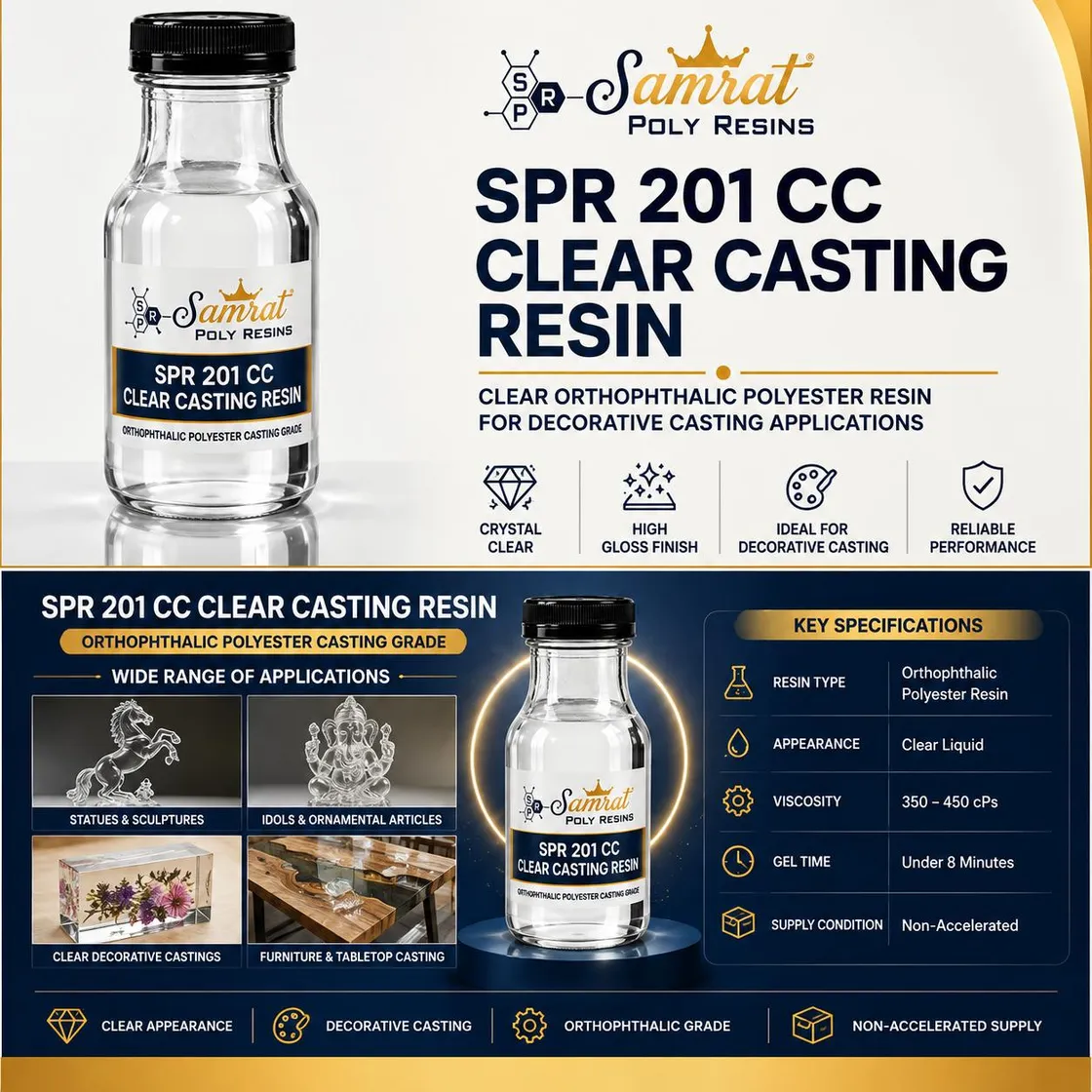
SPR 201 CC Clear Casting Resin
SPR 201 CCOrthophthalic polyester casting resin — not the two-part epoxy Clear Casting ResinSPR 201 · Orthophthalic Polyester Resins
Clear orthophthalic polyester casting grade for statues, idols, decorative articles and furniture top coats.
Review the official product data sheet for specifications and application information.
Price
Price on Request
Industrial resin pricing varies based on:
- Order Quantity
- Resin Grade
- Current Raw Material Rates
Product details
| Catalogue Code | SPR 201 CC |
|---|---|
| Resin Chemistry | Orthophthalic unsaturated polyester |
| Supply Condition | Non-accelerated |
| Reference Cure System | MEKP 1.5% + Cobalt Octoate 0.4% — added separately during use |
Typical specification
| Appearance | Clear liquid |
|---|---|
| Viscosity | 350–450 cPs |
| Gel Time | Under 8 minutes |
| Styrene Content | 33–40% |
Typical values from the Samrat Poly Resins product catalogue, 2026 edition. They are not guaranteed specifications or finished-component properties; confirm the current values for your order and trial the grade on your own process.
SPR 201 CC is a clear orthophthalic polyester casting resin from the SPR 201 family, listed for statues and idols, decorative articles and artefacts, and furniture top coats. It is supplied non-accelerated and cured with MEKP and cobalt octoate added separately during use. It is a polyester grade: it is a different product from the two-part epoxy Clear Casting Resin sold on this site, with its own chemistry, cure system and data.
Looking for the two-part epoxy casting system instead? That is the separate Clear Casting Resin (epoxy), with its own 2:1 mix ratio and TDS. For cast polyester buttons, the catalogue points to Button Grade Resin (SPR 201 BGR).
Key features
- Clear orthophthalic polyester casting grade (SPR 201 CC)
- Typical viscosity 350–450 cPs and gel time under 8 minutes
- Supplied non-accelerated; MEKP and cobalt octoate added during use
- Shares its typical specification with SPR 201 GPC, per the catalogue selection guide
Applications
- Statues and idols
- Decorative articles and artefacts
- Furniture top coats
Product role
The catalogue lists SPR 201 CC as its clear polyester casting grade for decorative and artistic castings. Its selection guide notes that the CC and CTG grades share the typical specification of SPR 201 GPC, GP Clear Resin — the difference is the product role each is listed for.
Casting behaviour depends on the section thickness, mould, fillers or pigments and the cure schedule used. Trial the grade on the actual casting before production; a gel time measured on a small sample is not the working time of a large pour.
Supply and cure
- Supply condition
- Non-accelerated
- Reference cure system
- MEKP 1.5% + Cobalt Octoate 0.4% — added separately during use
Processes and where this grade fits
SPR 201 CC is listed for casting and top-coat work, not for glass-fibre laminating. The table places it against the processes buyers most often ask about.
| Process or use | Role of this grade | What to confirm |
|---|---|---|
| Open-mould decorative casting — statues, idols, artefacts | Listed role | Section thickness, mould material and release, pigments or fillers, and heat build-up in the actual pour |
| Furniture top coats | Listed role | Substrate, film build, the sanding and finishing sequence and the cure schedule on the real panel |
| Polyester button casting | Not this grade’s listed role | The catalogue lists SPR 201 BGR, Button Grade Resin, for buttons |
| Glass-fibre hand lay-up and spray-up | Not this grade’s listed role | SPR 201 GPC, GP Clear Resin, is the laminating grade that shares this typical specification |
| Deep clear pours such as river tables | Different chemistry | The two-part epoxy Clear Casting Resin has its own mix ratio, pour depth and cure data |
Process-selection considerations
- Casting size decides the working window more than the product name does. The typical gel time — under 8 minutes at the reference cure — is a small-sample figure; a larger pour holds more heat and behaves differently.
- Pigments, metallic powders and fillers change clarity, cure speed and heat build-up. Test the exact colour and filler recipe, not a clear sample.
- The mould matters: rubber, FRP and metal moulds release and conduct heat differently. Confirm release and surface on the mould you will produce from.
- Decide whether the article is for indoor display or outdoor exposure. The catalogue does not publish UV-stabilisation or weathering data for SPR 201 CC; discuss outdoor use before selecting it.
- The reference cure, MEKP 1.5% with cobalt octoate 0.4%, is the catalogue’s stated condition. Settle the dosage for a given casting in trials with the technical team rather than by extrapolation.
Limitations and trial requirements
- Only liquid-resin typical properties are published: appearance, viscosity, gel time and styrene content. There is no published hardness, heat, weathering or shrinkage value for this grade.
- It is an unsaturated polyester cured with a peroxide initiator. It is not a two-part epoxy, and epoxy pour depths, mix ratios and cure times do not apply to it.
- Unsaturated polyesters shrink as they cure. Thick sections, sharp changes in section and rigid inserts are where cracking and distortion show up first, so they need the most careful trials.
- Trial the grade on the real part, mould and shop conditions before production. The catalogue values are typical liquid-resin properties, not guaranteed limits or finished-part performance.
Before you select this grade
- The values on this page are typical. Final selection should be confirmed against your own process, a trial result and the current technical documentation for the grade.
- The Technical Data Sheet linked on this page carries these same typical values. No Safety Data Sheet is published on this site for this grade; request current safety information before use.
- Never mix a concentrated peroxide initiator directly with a cobalt accelerator. Add each to the resin separately, according to the confirmed process.
- Store resin, initiators and accelerators separately, in original sealed containers, cool, shaded and away from heat and ignition sources. Use suitable personal protective equipment and adequate ventilation.