Low-Viscosity Isophthalic Resin
SPR 301 LVLow-viscosity isophthalic grade designed for jute reinforcementSPR 301 · Isophthalic Polyester Resins
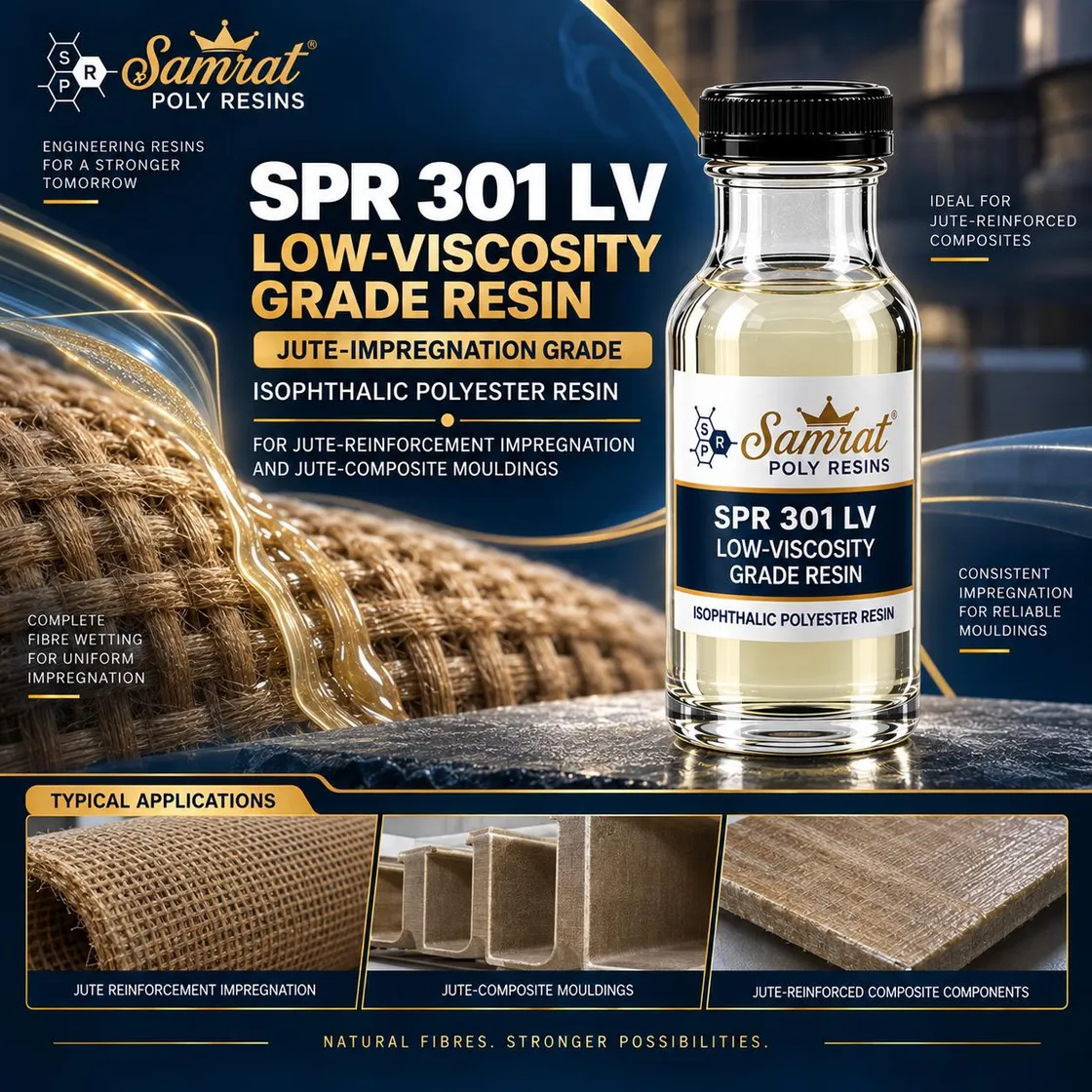
Low-viscosity isophthalic grade designed for jute reinforcement.
Review the official product data sheet for specifications and application information.
Price
Price on Request
Industrial resin pricing varies based on:
- Order Quantity
- Resin Grade
- Current Raw Material Rates
Product details
| Catalogue Code | SPR 301 LV |
|---|---|
| Resin Chemistry | Isophthalic unsaturated polyester |
| Supply Condition | Non-accelerated · non-thixotropic |
| Reference Cure System | MEKP 1.5% + Cobalt Octoate 0.2% — added separately during use |
Typical specification
| Appearance | Clear, water-white to light-straw liquid |
|---|---|
| Viscosity | 80–180 cPs at 25 °C |
| Gel Time | 40–90+ minutes at 25 °C |
| Specific Gravity | 1.03–1.09 |
| Styrene Content | 42–50% by weight |
Typical values from the Samrat Poly Resins product catalogue, 2026 edition. They are not guaranteed specifications or finished-component properties; confirm the current values for your order and trial the grade on your own process.
SPR 301 LV is the low-viscosity isophthalic grade of the SPR 301 family, designed, per the catalogue, for jute reinforcement: impregnation of jute reinforcement and jute-reinforced composite mouldings. It is supplied non-accelerated and non-thixotropic, with MEKP and a lower cobalt octoate dosage (0.2%) added separately during use.
The catalogue name for this grade is "Low-Viscosity Grade Resin"; its typical viscosity of 80–180 cPs is the lowest of the SPR 301 grades.
Key features
- Low-viscosity isophthalic grade for jute reinforcement (SPR 301 LV)
- Typical viscosity 80–180 cPs at 25 °C
- Long gel-time window, 40–90+ minutes at 25 °C
- Reference cure system uses cobalt octoate at 0.2%
Applications
- Impregnation of jute reinforcement
- Jute-reinforced composite mouldings
Product role
Natural-fibre mats such as jute are thicker and more absorbent than glass, and a laminating resin of ordinary viscosity can leave dry fibre in the middle of the mat. SPR 301 LV is the catalogue's low-viscosity isophthalic grade designed for that impregnation.
Jute's moisture content affects wet-out and cure. Condition the reinforcement and trial the grade on the actual jute product before production.
Supply and cure
- Supply condition
- Non-accelerated · non-thixotropic
- Reference cure system
- MEKP 1.5% + Cobalt Octoate 0.2% — added separately during use
Processes and where this grade fits
SPR 301 LV is a low-viscosity, non-thixotropic isophthalic grade designed to impregnate jute reinforcement, which is thicker and more absorbent than glass mat.
| Process or use | Role of this grade | What to confirm |
|---|---|---|
| Impregnation of jute mats and fabrics | Listed role | Jute moisture content, mat weight and how fully the mat wets through |
| Jute-reinforced composite mouldings | Listed role | The moulding process, part thickness and the cure schedule |
| Glass-fibre hand lay-up | Not the listed role | GP Clear Resin or ISO Polyester Resin |
| Filament winding | Consider SPR 301 FW | The catalogue’s filament-winding grade |
Process-selection considerations
- Low viscosity is the reason to choose it: 80–180 cPs at 25 °C typical, for penetrating a thick natural-fibre mat.
- Control jute moisture. Natural fibres carry water, which affects wet-out and cure; condition the reinforcement and test at production moisture.
- The long typical gel time, 40–90+ minutes at 25 °C, allows time for impregnation of thick mats. Plan demoulding around it.
- Note the lower reference cobalt dosage: MEKP 1.5% with cobalt octoate 0.2%, added separately.
- Describe the finished jute product and its service environment when enquiring.
Limitations and trial requirements
- The catalogue publishes liquid-resin typical properties only. Jute composite strength, moisture uptake and durability depend on the fibre and construction and are not published.
- The high styrene content, 42–50% by weight typical, means ventilation and styrene exposure control deserve particular attention.
- Jute products from different sources vary; one successful trial does not qualify another mat.
- Trial the grade on the real part, mould and shop conditions before production. The catalogue values are typical liquid-resin properties, not guaranteed limits or finished-part performance.
Before you select this grade
- The values on this page are typical. Final selection should be confirmed against your own process, a trial result and the current technical documentation for the grade.
- The Technical Data Sheet linked on this page carries these same typical values. No Safety Data Sheet is published on this site for this grade; request current safety information before use.
- Never mix a concentrated peroxide initiator directly with a cobalt accelerator. Add each to the resin separately, according to the confirmed process.
- Store resin, initiators and accelerators separately, in original sealed containers, cool, shaded and away from heat and ignition sources. Use suitable personal protective equipment and adequate ventilation.