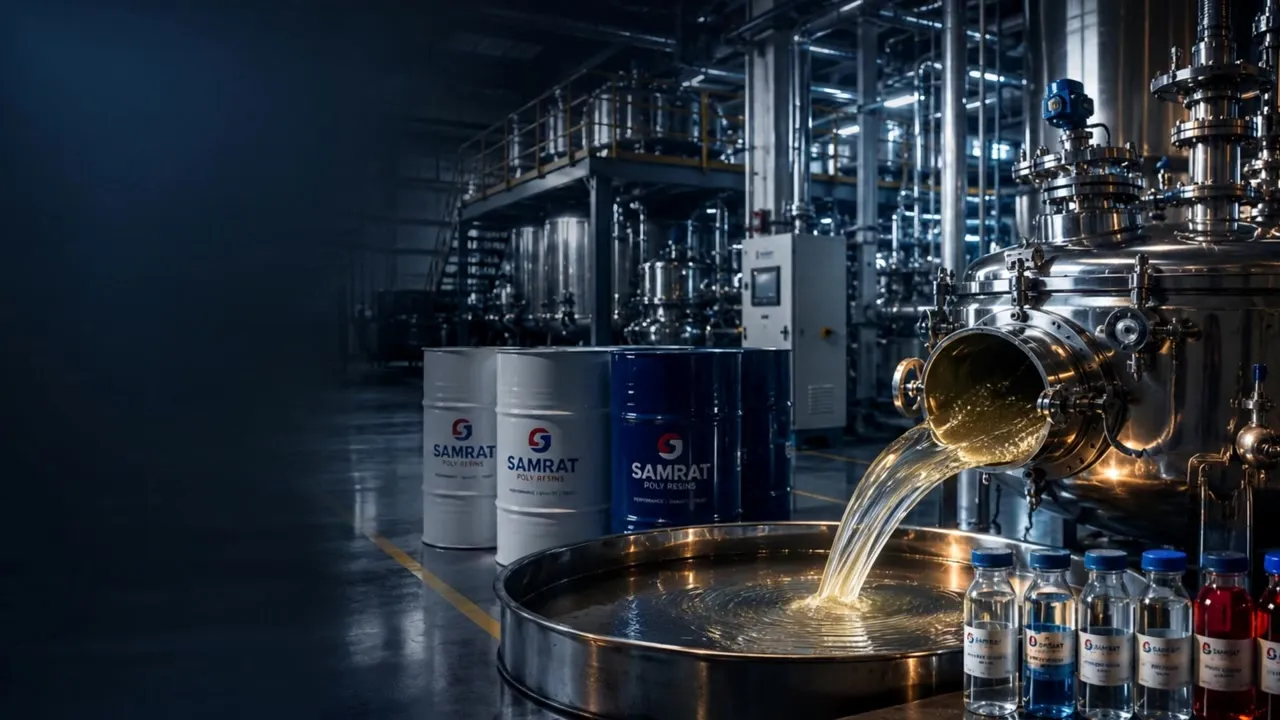

Overview of GP Polyester Resin Applications
GP polyester resin's popularity comes from how broadly it applies, not from excelling at any single task. Because it strikes a workable balance between mechanical strength, ease of processing and cost, the same underlying resin chemistry shows up across water storage tanks, roofing sheets, door skins, industrial mouldings, and a range of construction and marine products.
What determines whether GP resin is the right fit for a given application is a combination of factors: the mechanical load the finished part will carry, the chemical and weather exposure it will face in service, the manufacturing process used to produce it, and the cost sensitivity of the end product. GP resin tends to perform well wherever these requirements sit in the moderate range, and less well where any one of them becomes extreme.
This article walks through the main categories where GP resin is used in practice — FRP moulding, construction and building products, and marine and industrial fabrication — and closes with guidance on how to narrow down the right application-specific grade rather than treating "GP resin" as a single interchangeable product.
FRP Manufacturing and Moulding
Open-Mould Components
Hand lay-up and spray-up, the most widely used FRP moulding methods, rely on GP resin's workable gel time and viscosity to build up a laminate over an open mould. This covers everything from custom enclosures and covers to one-off or low-volume structural components.
Moulded Enclosures and Covers
Equipment housings, machine guards and protective covers are commonly moulded in GP resin laminate, taking advantage of its rigidity, moderate impact resistance and ability to be moulded into complex shapes that would be harder or costlier to produce in metal.
Decorative and Architectural Mouldings
GP resin's compatibility with pigments and its smooth cured finish make it a practical choice for decorative panels, signage and architectural trim, where consistent colour and surface quality across a production run matter as much as strength.
Construction and Building Products
Roofing and Roof-Light Sheets
In continuous lamination lines, GP resin is used to produce both structural FRP roofing sheets and translucent roof-light panels, where UV-stabilised formulations help the sheet hold its clarity and colour under long-term outdoor exposure.
Door Skins
FRP door skins are moulded from GP resin to reproduce fine surface detail — wood-grain textures, panel profiles — while providing the rigidity and impact resistance expected of a door facing.
Cladding, Formwork and Structural Liners
Beyond roofing and doors, GP resin is used in cladding panels, concrete formwork and structural liners, where its balance of strength, mould detail and cost suits general building applications better than higher-cost speciality resins.
Marine and Industrial Fabrication
In marine work, GP resin is generally reserved for components that are not subject to prolonged water immersion or heavy structural loading — trim pieces, non-structural fittings and similar parts — since sustained contact with water is exactly the condition where GP resin's moderate chemical resistance is most likely to fall short over time.
In industrial fabrication more broadly, GP resin is used for ducting, enclosures, covers and process equipment where the chemical environment is mild and the priority is a durable, corrosion-resistant alternative to metal at a reasonable cost. Where a process involves aggressive chemicals or continuous immersion, fabricators typically step up to an isophthalic or vinyl ester resin instead.
This is the recurring theme across marine and industrial use: GP resin is the practical first choice, and the decision to move to a speciality resin is driven by a specific exposure condition that GP resin isn't formulated to handle indefinitely, rather than a general dissatisfaction with its performance.
Selecting the Right Application-Specific Grade
Because GP resin covers such a wide span of end uses, the practical question for a buyer is rarely "should I use GP resin" but "which GP resin grade suits this specific application and process." Two products both labelled general-purpose can have meaningfully different viscosity, gel time and mechanical performance once you check their technical data sheets side by side.
Best Practice
- Start from the finished part's exposure and load, not the resin's category label
- Confirm viscosity and gel time suit your specific manufacturing process
- Check the technical data sheet (TDS) rather than assuming a general figure applies
- Move to a speciality resin (isophthalic, vinyl ester, fire-retardant) where exposure genuinely demands it