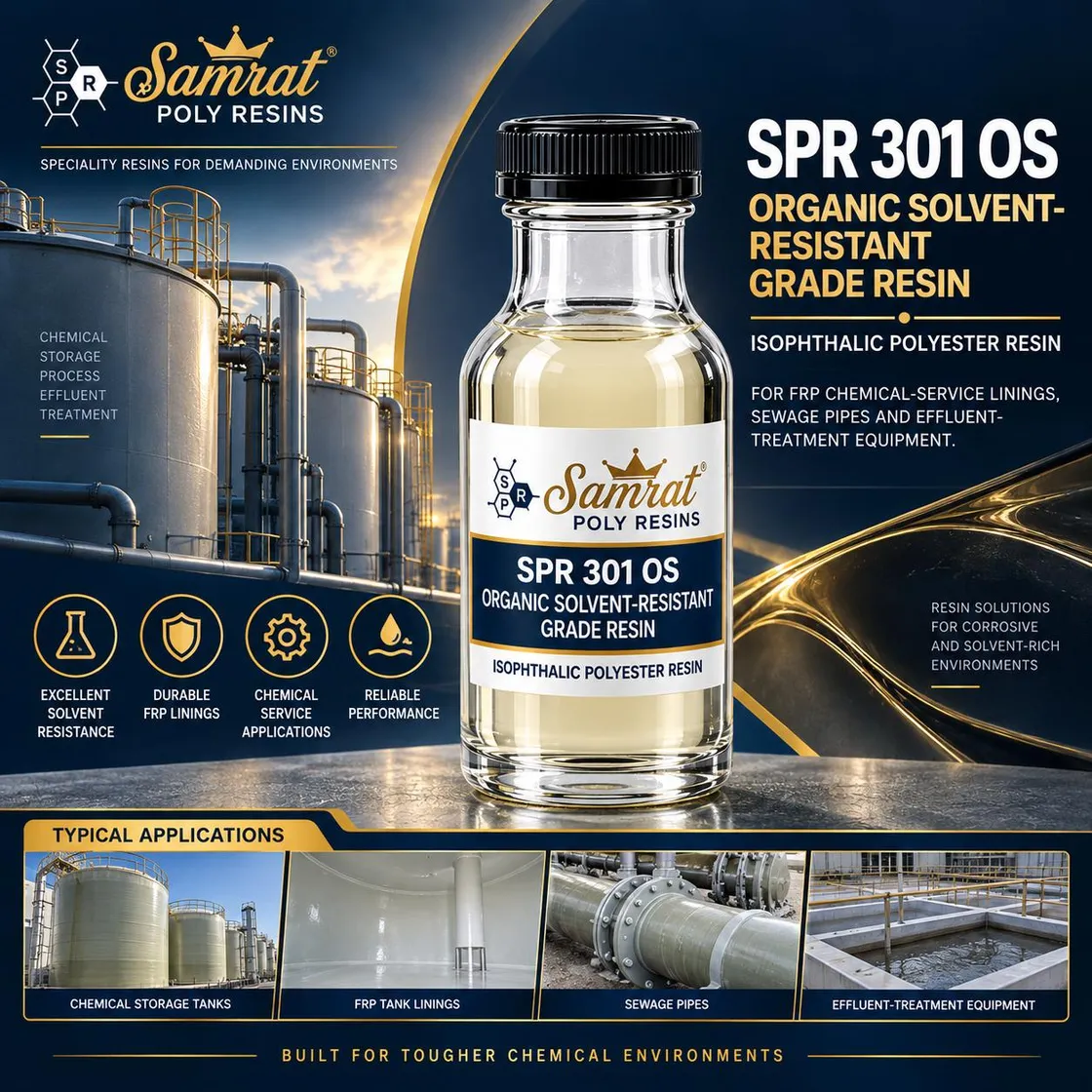
Organic Solvent-Resistant Grade Resin
SPR 301 OSAnti-corrosive isophthalic polyester gradeSPR 301 · Isophthalic Polyester Resins
Isophthalic grade with corrosion resistance against organic solvents and good chemical and heat resistance.
Review the official product data sheet for specifications and application information.
Price
Price on Request
Industrial resin pricing varies based on:
- Order Quantity
- Resin Grade
- Current Raw Material Rates
Product details
| Catalogue Code | SPR 301 OS |
|---|---|
| Resin Chemistry | Isophthalic unsaturated polyester |
| Supply Condition | Non-accelerated · non-thixotropic |
| Reference Cure System | MEKP 1.5% + Cobalt Octoate 0.4% — added separately during use |
Typical specification
| Appearance | Clear, light-straw to reddish-amber liquid |
|---|---|
| Viscosity | 200–400 cPs at 25 °C |
| Gel Time | 15–35 minutes at 25 °C |
| Specific Gravity | 1.03–1.15 |
| Styrene Content | 35–50% by weight |
Typical values from the Samrat Poly Resins product catalogue, 2026 edition. They are not guaranteed specifications or finished-component properties; confirm the current values for your order and trial the grade on your own process.
SPR 301 OS is an anti-corrosive isophthalic polyester grade from the SPR 301 family, described in the catalogue as having corrosion resistance against organic solvents and good chemical and heat resistance. It is listed for FRP linings for organic-solvent storage, sewage pipes and effluent-treatment equipment, and is supplied non-accelerated and non-thixotropic, with MEKP and cobalt octoate added separately during use.
For oil-storage-tank linings the catalogue lists SPR 301 OT; for broad corrosion-resistant FRP linings and structures, the vinyl ester route is Vinyl Ester Resin (SPR 501 VE).
Key features
- Anti-corrosive isophthalic grade (SPR 301 OS)
- Corrosion resistance against organic solvents, per the catalogue
- Typical viscosity 200–400 cPs and gel time 15–35 minutes at 25 °C
- Supplied non-accelerated and non-thixotropic
Applications
- FRP linings for organic-solvent storage
- Sewage pipes
- Effluent-treatment equipment
Product role
"Organic solvent" covers very different chemicals, and a laminate that tolerates one may not tolerate another. The catalogue positions SPR 301 OS for solvent storage, sewage and effluent service; the specific solvent, its concentration and temperature decide whether it suits a given lining.
Chemical-resistance language is not a universal compatibility chart. Share the medium, concentration, temperature and lining construction for a service-specific review.
Supply and cure
- Supply condition
- Non-accelerated · non-thixotropic
- Reference cure system
- MEKP 1.5% + Cobalt Octoate 0.4% — added separately during use
Processes and where this grade fits
SPR 301 OS is a non-thixotropic, anti-corrosive isophthalic grade. Its listed roles are solvent-storage linings and sewage and effluent service.
| Process or use | Role of this grade | What to confirm |
|---|---|---|
| Hand lay-up of linings for organic-solvent storage | Listed role | The named solvent, concentration, temperature and lining construction |
| Sewage pipes | Listed role | Pipe process, diameter, burial or above-ground service and the governing specification |
| Effluent-treatment equipment | Listed role | The effluent composition, pH range, temperature and the equipment type |
| Oil-storage-tank linings | Consider SPR 301 OT | The catalogue’s oil-storage-tank grade |
| Highly corrosive chemical service | Consider vinyl ester | SPR 501 VE, Vinyl Ester Resin |
Process-selection considerations
- Identify the solvent by name. Aromatic, aliphatic, chlorinated and oxygenated solvents attack laminates differently; "organic solvent" is not enough to select on.
- Give concentration, temperature and whether contact is continuous immersion, splash or vapour.
- For sewage and effluent, describe the stream: municipal or industrial, pH range, temperature and any cleaning chemicals.
- Being non-thixotropic, the grade flows readily at 200–400 cPs typical; vertical lining work needs attention to drainage.
- Reference cure: MEKP 1.5% with cobalt octoate 0.4%, added separately. Typical gel time is 15–35 minutes at 25 °C.
Limitations and trial requirements
- No chemical-resistance chart, concentration limit or maximum service temperature is published for SPR 301 OS.
- Chemical-resistance wording describes the grade’s positioning, not a guarantee against a particular solvent.
- The catalogue publishes liquid-resin typical properties only; cured-laminate performance must be established for the construction.
- Trial the grade on the real part, mould and shop conditions before production. The catalogue values are typical liquid-resin properties, not guaranteed limits or finished-part performance.
Before you select this grade
- The values on this page are typical. Final selection should be confirmed against your own process, a trial result and the current technical documentation for the grade.
- The Technical Data Sheet linked on this page carries these same typical values. No Safety Data Sheet is published on this site for this grade; request current safety information before use.
- Never mix a concentrated peroxide initiator directly with a cobalt accelerator. Add each to the resin separately, according to the confirmed process.
- Store resin, initiators and accelerators separately, in original sealed containers, cool, shaded and away from heat and ignition sources. Use suitable personal protective equipment and adequate ventilation.