
What is actually in a finished putty
A finished body filler is an unsaturated polyester dissolved in styrene, heavily loaded with mineral and hollow fillers, thixotroped, pigmented and supplied as a paste. Published analyses of commercial repair putties put the composition envelope at roughly a third unsaturated polyester, ten to twenty per cent styrene, and something close to half the mass as inorganic filler.
Patent literature describes total filler anywhere from a quarter to eighty per cent by weight, with the practical preference sitting in the thirty-five to sixty per cent band. Whichever figure you take, the headline is the same: more than half of what a putty maker sells is not resin.
That single fact drives the whole specification. The resin has to accept an enormous mineral load and still behave like a knife-spreadable paste that does not slump off a vertical door skin, cures reliably in a humid workshop, and sands cleanly minutes later.
Why putty resin is usually pre-accelerated, and why that matters for safety
Most putty-grade resins are supplied pre-thixotroped and pre-accelerated, with a tertiary amine promoter already in the drum. Peroxide producers describe the two-component putty architecture in exactly these terms: a paste or powder side carrying filler, pigment and the peroxide, and a liquid side that is polyester resin with a built-in amine accelerator.
This is a commercial convenience and a technical necessity. It lets the formulator set working time by balancing the peroxide level on one side against the amine level on the other, and it means the finished putty cures on demand at ambient temperature.
It also carries the single most important safety consequence on this page. If the resin already contains an amine accelerator, then a drum of it is a drum of accelerated resin. Peroxides and accelerators must never be brought together directly, because the reaction can be violent. The correct order is always accelerator into resin first and peroxide last, each handled separately. A plant receiving pre-accelerated resin needs to know that before the first delivery, not after.
What a putty formulator actually asks of the resin
Filler acceptance comes first. The resin must wet out and carry the target mineral load and still spread. Low resin viscosity buys loading headroom, but too low and the paste sags. Resin demand depends as much on the filler's oil absorption and particle shape as on the resin itself.
Thixotropy is second. The paste must yield instantly under the spreader and rebuild before gel. Some resins come pre-thixotroped; others leave it to the formulator's fumed silica and microcrystalline talc. There is no industry-standard thixotropic index for putty, so any figure is meaningless without the spindle, the speeds, the temperature and the equilibration time.
Then reactivity and pot life, where gel time at twenty-five degrees is the most quoted number and is a property of the supplied pre-accelerated resin rather than of the peroxide dose alone. Then base colour, because a dark resin forecloses light-coloured putties. Then adhesion, shrinkage, sandability, thin-film surface cure, styrene content and shelf stability.
Adhesion is a resin-level property, not just a preparation question
It is tempting to treat adhesion as the body shop's problem, solved by sanding to the right grit. It is partly a resin problem too, and the clearest evidence is galvanised steel.
Zinc coatings interfere with the interfacial cure of materials that harden by free-radical polymerisation, which retards cure at the bond line and delays the point at which the repair can be sanded. Patent literature exists specifically to address adhesion failure on galvanised sheet, and backbone chemistry is one of the levers: dicyclopentadiene-backbone putty resins are marketed on exactly this property.
So when a formulator asks whether a resin sticks to galvanised and aluminium rather than only to cold-rolled steel, that is a substantive question about the resin, and the answer should come with a test method and a stated failure mode rather than a yes.
Air inhibition and why putty resins are sold on air drying
Free-radical cure of unsaturated polyester is inhibited by atmospheric oxygen at the exposed surface. Left unaddressed it produces the classic complaint of a filler that is hard underneath and tacky on top, sometimes persisting for a very long time.
The conventional countermeasure is a small quantity of paraffin wax that is incompatible with the resin, migrates to the surface during cure and forms a physical oxygen barrier. Putty resins are therefore often described by their air-drying or tack-free character, and that is a genuinely separate property from through-cure and from sandability.
This matters commercially because the sanding window is the formulator's main selling point to a body shop. A putty that cannot be sanded promptly costs labour on every repair.
Backbone chemistry changes the putty
Putty-grade resins are built on orthophthalic, isophthalic or dicyclopentadiene backbones, and the choice is not cosmetic.
Dicyclopentadiene grades are associated with lower cure shrinkage, faster surface cure and better adhesion to galvanised sheet, which is why several commercial putty resins use them. Orthophthalic grades are the cost-driven route and typically accept high filler loading. Isophthalic grades appear where moisture resistance in the cured putty matters more.
Cure shrinkage is worth understanding here. All of it comes from the crosslinking of styrene with the polyester, so a heavily filled putty shrinks far less than the neat resin simply because half of it is inert mineral. Excess shrinkage shows up downstream as edge mapping and sand-scratch telegraphing through the topcoat, which is the body shop's complaint but the formulator's problem.
What to establish before you buy
State your filler package and loading target, your mixing equipment, and whether you use hollow microspheres, since those constrain the shear you can apply. State the working time and sanding window you are selling to, your target colour, and which peroxide system your finished product uses.
Ask the supplier whether the grade is pre-accelerated and with what, what peroxide system it is designed for, what the shelf life and gel-time drift behaviour are, and what parameters appear on the batch certificate.
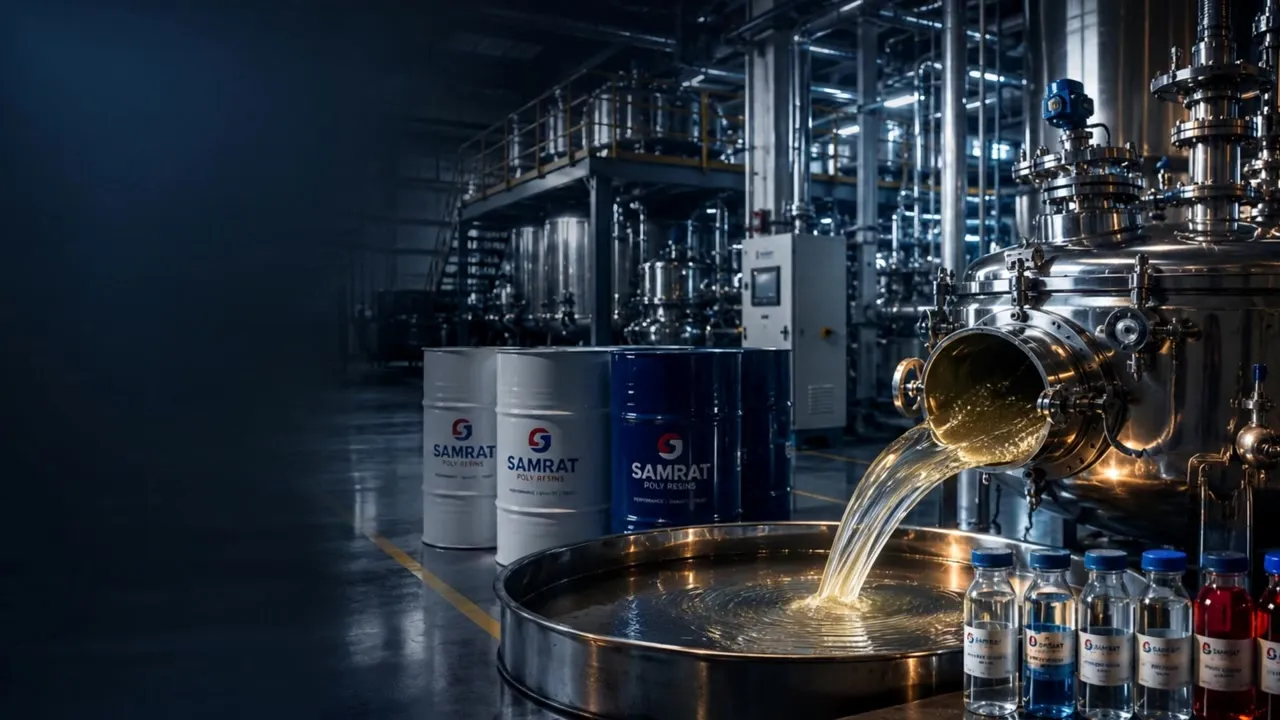
Samrat Poly Resins manufactures Polyester Putty Resin at Doraha, Punjab. Grade-specific values are confirmed at enquiry rather than published as generic figures, because a gel time or viscosity quoted without the peroxide system, the temperature and the measurement conditions is not usable by a formulator.