
Start with the duty, not the product name
The most common procurement error in this category is asking for corrosion-resistant resin. That phrase covers everything from a damp outdoor panel to a hot concentrated acid line, and the two requirements are several rungs apart on the resin ladder.
Define the duty instead. What will the laminate contact? At what concentration? At what temperature, including any excursions above normal running? Is contact continuous, intermittent or occasional splash? How long must the part last? Those five answers narrow the choice faster than any other information you can provide.
Describe the construction you intend to build
For corrosion service, how the laminate is built matters at least as much as which resin goes into it. Say whether you intend a resin-rich corrosion barrier with a surfacing veil at the contact face, how many mat plies back it, and what the structural laminate is.
A vessel with an excellent resin and a poorly built barrier will fail at the barrier. A vessel with a modest resin and a properly built, void-free, fully cured barrier will often outlast it. If you are unsure about the construction, that is a better conversation to have before ordering than after commissioning.
Mention the fabrication process explicitly: hand lay-up, spray-up, filament winding, RTM or pultrusion. Reactivity and viscosity requirements differ considerably between them, and a grade suited to hand lay-up is not automatically suited to winding.
Be realistic about cure, because the resistance depends on it
Chemical and hydrolytic resistance are properties of a fully crosslinked network. A laminate that has gone hard has not necessarily finished curing, and an undercured corrosion barrier will underperform badly regardless of which resin was specified.
Say whether your facility can post-cure, and at what temperature and for how long. Say what ambient conditions the laminate will cure in, because a cold workshop changes cure development significantly. Say how you verify cure, whether by Barcol impressor hardness or another method.
If post-curing is impossible in your plant, that is important information rather than something to leave unsaid. It may change the sensible recommendation.
Name any code or specification in its original wording
If the project cites BS 4994, EN 13121, a client specification, a consultant's document or a tender clause, send the wording as written. Summarising a clause into a product nickname is where most mis-specification begins.
The same applies to test methods. If the specification calls for chemical resistance evaluated to ASTM C581, mechanical properties to ASTM D638 and D790, heat distortion to ASTM D648 or water absorption to ASTM D570, list them. Knowing which evidence is actually required prevents both over-promising and wasted testing.
Where a potable-water or food-contact approval is required, state it as a separate requirement. It is a regulatory and testing question about a finished construction, not a property of a resin family, and it needs to be handled on its own terms.
What to ask a supplier, and what a supplier cannot tell you
Reasonable requests include the grade's identity and chemistry, packaging and pack size, shelf life and storage conditions, batch traceability, and what documentation accompanies a delivery.
What no supplier can honestly give you is a guarantee that a finished vessel will survive a particular duty. Service life depends on the resin, the reinforcement, the construction, the workmanship, the cure and the actual operating conditions. Treat a chemical-resistance chart as a screening tool generated under specific conditions rather than an approval of your application.
Be equally cautious with figures quoted out of context. A viscosity or gel time is meaningful for a named grade at a stated temperature, and transferring a number from one grade or one supplier's sheet to another is how selection errors propagate.
Commercial details worth settling early
Quantity and call-off pattern, packaging preference, delivery location and lead time expectation should travel with the technical enquiry rather than following it. Resin has a finite shelf life and defined storage requirements, so ordering pattern and storage conditions are part of the technical conversation, not separate from it.
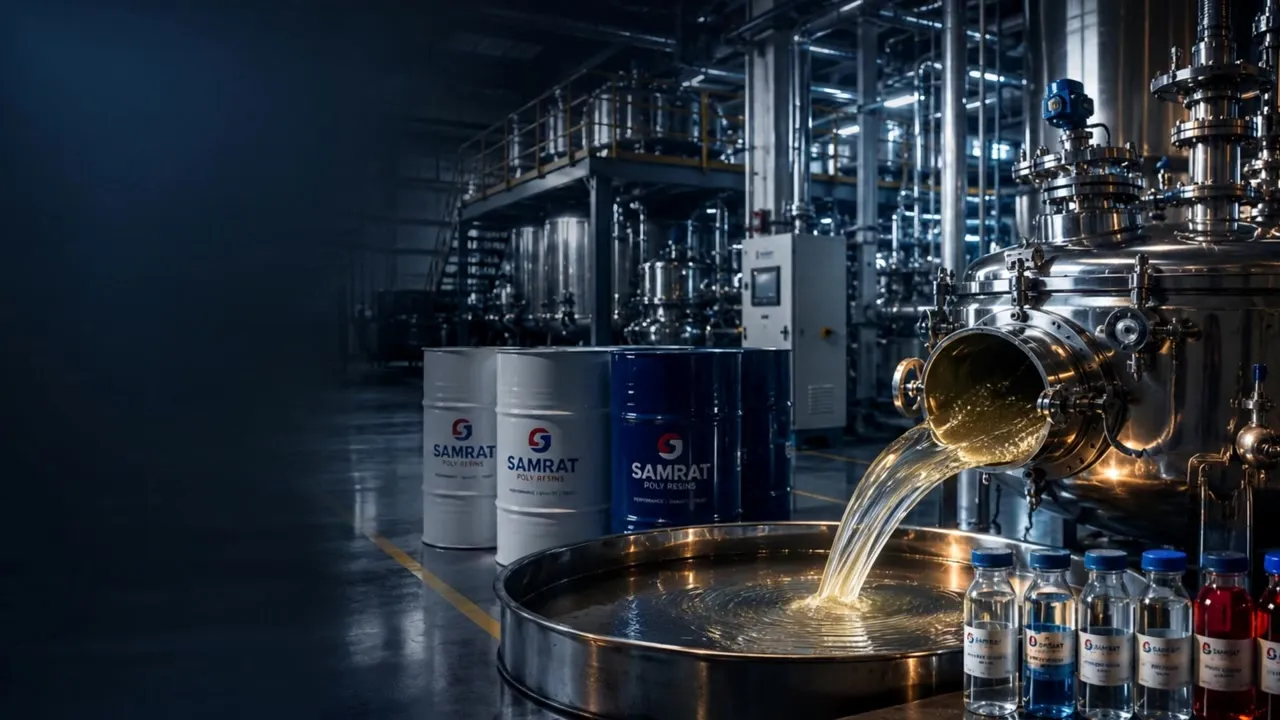
Samrat Poly Resins manufactures ISO Polyester Resin at Doraha, Punjab, and supplies it in 225 kg drums. Typical values are published on its TDS (SPR-TDS-IPR); confirm the current batch values with your order.
A short enquiry template
Finished component and its function. Medium in contact, with concentration. Operating temperature and any excursions. Exposure pattern and expected service life. Fabrication process. Intended laminate construction, including whether a corrosion barrier is planned. Cure and post-cure capability. Any code, specification or test method in original wording. Quantity, packaging, delivery location and timing.
An enquiry containing those eleven items can be answered properly. One that says corrosion-resistant polyester resin, urgent, usually cannot.